


Open June 1 to August 31
Wednesday to Sunday 11:00am – 4:00pm
Saturday 10:00am – 6:00pm
Admission by Donation
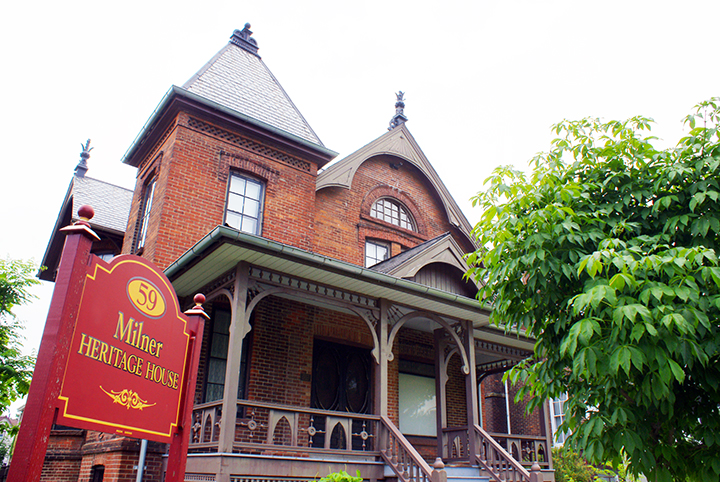
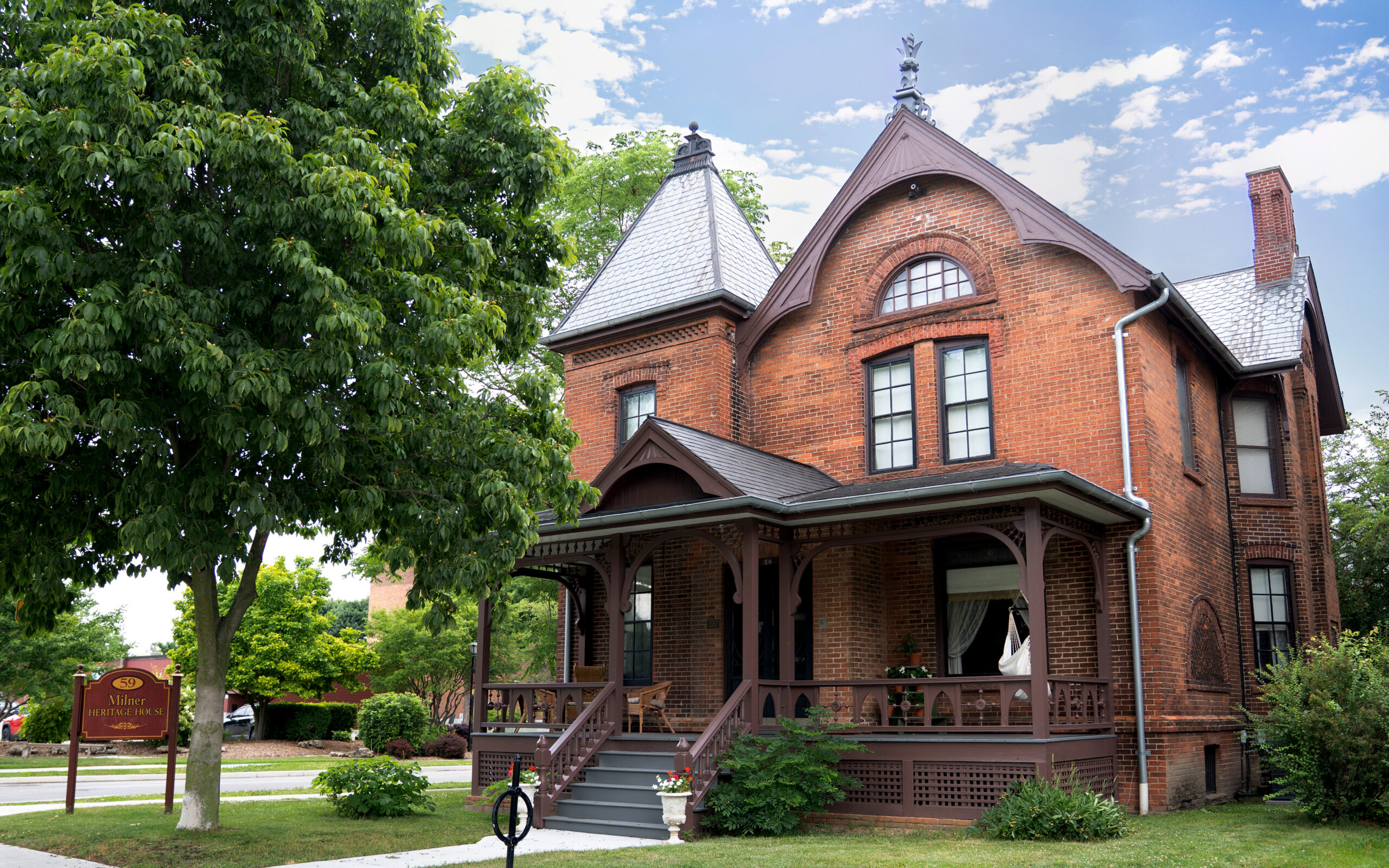
The Milner Heritage House, located at 59 William Street North in Chatham, Ontario, tells the story of a prominent local family whose influence helped shape the city’s industrial and cultural identity in the late 19th and early 20th centuries.
The house was built in 1894 by Robert Milner, a successful businessman who had established the Milner Carriage Works, a buggy and sleigh manufacturing company that began modestly in Chatham. By the 1890s, his enterprise had grown into one of the largest vehicle producers in southern Ontario. As the business expanded, Robert became known as one of Chatham’s early “Captains of Industry.”
Robert’s wife, Emma Milner (née Wicks), married him in 1874 at the age of 19. Despite having no formal training, Emma developed into a highly respected artist. She specialized in crayon-style pencil stipple portraits and gained recognition for her intricate, award-winning works. The Milners had seven children, and their home reflected both their success and their values—combining industrial achievement with artistic expression.
The house itself was designed in the Queen Anne architectural style, characterized by asymmetrical façades, decorative trim, and spacious interiors. It was built on the corner of William and Murray Streets, directly reflecting the status and taste of the Milner family at the time.
Following Emma’s death in 1936 and Robert’s in 1941, their children donated the house to the City of Chatham in 1943. It served as the Chatham-Kent Museum for over 45 years. During that time, it preserved and displayed local history and artifacts, and played a vital role in heritage education for the region.
In later years, the house was carefully restored to reflect life in 1905, showcasing what a successful industrialist’s home would have looked like during that period. While no longer the primary site of the Chatham-Kent Museum, the Milner Heritage House continues to serve as an important piece of Chatham’s architectural, industrial, and artistic legacy.
Step back in time and discover Chatham in 1905. Watch a tour of the Milner Heritage House!
Robert Milner was born in England to James Milner (English) and Grace Bell (Scottish). Grace Bell was James’ second wife, and Robert was James’ 12th child. He immigrated to Canada with his family at age 3 and lived in London, Ontario, until he was 18.
Emma Wicks was born on a farm in Chatham Township. She married Robert in 1874, when she was 19.
Milner was an accomplished artist but had no formal training. She specialized in hyper-realistic crayon portraits using a pencil stippling technique. Most of her drawings date from the 1880s.
Milner entered many competitions and won several awards throughout Ontario. During one competition, the judges didn’t believe that her submission was actually a drawing. Robert had to remove it from the frame to prove to the judges that it was her work.
Rufus Milner (1875-1943)
Nugent Milner (1878-1951)
Nugent Milner worked as a blacksmith. He worked for the Ford Motor Company and family oral history says that he forged the first prototype Henry Ford’s first car.
Aubrey Milner (1880-1967)
Blanche Venus Milner (1882-1896)
When Blanche was fourteen years old, she fell down the maid’s staircase and tragically died in the hospital.
Basil Milner (1885-1943)
May Milner (1890 – 1918)
Douglas Franklin Milner (1893-1936)
Milner got his start in the carriage business as an apprentice to William Gray. He worked in partnership with other carriage makers through the 1870s and into the 1880s.
Milner eventually purchased the carriage works of William Young on the corner of Wellington and Adelaide Streets and founded Milner Carriage Works independently. Milner Carriage Works moved to William Street South (where the Judy LaMarsh building is currently) in 1889 because the Canadian Pacific Railway set up a station at ___ & ___.
Milner’s company motto was “Quality. Not Quantity.”
Milner was one of the last carriage makers in the province. His business continued into the early 1920s, well after most of his competitors closed their doors or converted to automobile production.
Milner Heritage House was built in 1894 in a Queen Anne style of architecture.
Some key elements to this style are:
The house was designed by Architect James L. Wilson. Wilson was born in Waterloo County in 1848. He was educated at Chatham Collegiate Institute and Canada Business College in Chatham. In 1886, he opened his office as an architect in Chatham.
This neighbourhood was quite a luxurious part of town in 1905.
Tecumseh Park would have been full of people daily. The river was busy with boats and small ships transporting goods up and down the Thames.
Construction had just been completed on the Armoury.
The Hotel Sanita opened for business across Murray Street, offering mineral water baths.
The house behind Milner House on Murray Street was used as a school operated by the Ursuline Sisters.
The front parlour was a sitting room for guests.
It was very common to have a portrait of King Edward VII in your home in 1905 because, even after Confederation, many Canadians maintained a close connection to the British monarchy.
King Edward VII was born at Buckingham Palace on November 9, 1841. He became king in 1901. King Edward VII died May 6, 1910.
The period of King Edward’s reign is known as the Edwardian era. The period is known for its economic prosperity.
These family portraits are all drawn by Emma Milner – one of Robert Milner, a self-portrait of Emma Milner, one of the five boys, and one of the two girls.
This is a photograph taken with a camera of the five Milner sons while on a sledding excursion. This is the photo that Emma used to create the drawing of her sons.
There are two Canadian Prime Ministers on display in the front parlour!
Sir Charles Tupper was the shortest-serving Prime Minister in Canadian history – he served only 69 days in the summer of 1896. The statute (made of plaster and painted gold) was commissioned in Wolfville, Nova Scotia, in 1889.
Tupper has an interesting connection to Chatham-Kent in that Tupperville was named after him.
Decorative plates were quite common, especially ones with famous figures on them. Sir John A. Macdonald was Canada’s first Prime Minister – he served as Prime Minister 1867-1873 & 1878-1891.
This piano is labelled, “Tyrell’s Parlour Grand, Chatham City, Ont.” The piano may have been built in Chatham, but it is also possible that just the label was painted here.
The keys are made of walnut and ivory, while the body is made of tulipwood. The vertical ovals in the wood are an unusual feature in pianos from this time, indicating it could have been built here.
This table is special to the museum because it belonged to the Milner family. It is carved from a knurled piece of wood and is quite heavy. It is believed that Robert may have carved this table himself since he owned a furniture store after he closed his Carriage Works in 1920.
The corner shelf is known as a “whatnot.” Victorians often preferred to have their houses filled with clutter, and this type of shelf was particularly well-suited for this purpose. This piece of furniture was also owned by the Milners.
A gramophone is a mechanical device used to play music. This gramophone is powered by tension created when the crank is turned. The tension spins the disc with grooves. The needle traces the grooves, converting the physical vibrations into audible sound waves that are amplified by the horn.
The logo of the dog listening to ‘His Master’s Voice’ is based on a painting of a real dog that would listen to the Gramophone. This painting was sold to The Gramophone Company in 1900. In 1908, the company changed its name to HMV (for His Master’s Voice).
The Magic Lantern was a popular toy in the late 19th and early 20th century. A candle or oil lamp is placed inside to create light. The light shines through a lens and projects the image from the glass slide onto a screen. A performer would move the slide along slowly and tell a story. Occasionally they might make funny voices, tell jokes, or play the piano along with it.
A stereoscope is a device for viewing stereographic cards. These cards contain two separate images that are printed side-by-side to create the illusion of a three-dimensional image. Stereoscopes were a form of entertainment for children and adults. Stereoscope cards might tell stories or show images of far-off places.
This kaleidoscope is a reproduction of the common toy. Using mirrors and coloured glass, kaleidoscopes create shapes and patterns when viewed through the aperture. Kaleidoscopes work best when pointed towards the window.
The Milners would have eaten most of their meals here in the dining room. There are pocket doors which could close this room off while dinner was being served.
There are three portraits by Emma Milner on display in the dining room.
This is Aubrey Milner, the third son of Robert & Emma Milner.
This is likely Nugent Milner with the dog, although it could be one of his brothers.
This may be the same actress as the portrait in the back parlour. It may be Lillie Langtry, who worked very closely with Sarah Bernhardt, but we aren’t certain.
This instrument is fully restored (although probably badly out of tune). It requires pumping the right pedal for it to play. The Milners probably would have enjoyed dinner music. The keys are made of Walnut and Ivory.
There are two types of silver on display, Sterling Silver and Silver Plated.
Sterling Silver is 92.7% silver and 7.5% of another metal, usually copper. This was very expensive. It maintains a mirror-like quality when shined.
In the mid-19th century, a process called electroplating made it possible to plate objects with silver. They looked the same but were much cheaper. By now, most of the silver plating has worn off, and they are not shiny anymore.
The Kitchen is the room where all the cooking and cleaning would have been done. This was done primarily by the maid, but Emma would have helped out quite a bit. The floorboards in this room are the original floorboards to the house. There is some evidence of restoration by the door.
This wood burning, cast iron range was made by Malleable Range. Although it is stamped as Chatham (in a different font) in the top corners, it was not likely built here, as there is no evidence of a stove factory at that time.
Warming drawers are at the top for plates and food. A reservoir on the right side would be used to keep water warm. A movable handle allowed for lifting of the burners.
This wooden ice box is lined with tin. The top opens to the compartment for a large block of ice. There is a pipe that allows water to be drained. The bottom door opens to the area where milk, eggs, ice cream and sherbet could be kept.
Ice would have to be delivered. It was carried into the house in large blocks using a set of iron tongs. In the wintertime, it would be cut out of the river and stored in warehouses (sometimes partially underground). The ice was packed tight with straw which allowed it to last through the summertime.
This locally manufactured cupboard was made by the Manson Campbell Company. It was sold all over Canada, some US states, and parts of Western Europe.
It was said that, at this cupboard, a woman could sit down, make a pie in 30 minutes, and not have to get up once except to put it in the oven.
The cupboard is set up based on an advertisement from the period. The large drawer on the bottom right is lined with tin and was probably for flour. The cupboard under the mirror was probably for sugar. There is an alternate model that had a flour sifter in the top left portion of the cupboard.
At the turn of the 20th century, telephones were still a novelty, confined mostly to the homes of the wealthy. The Milners’ phone may have used a “party line” for local calls, in which the call could be heard by anyone who had a locally-connected phone, but it is likely that they paid extra to subscribe to a private line.
The Milner’s would have taken most of their meals in the dining room, but it is possible they would have also sometimes eaten in the kitchen as well, especially the children.
The kitchen table also would have been used as a workspace for cooking and for the maid’s meals.
This room represents a typical girl’s room of the time.
Learning embroidery usually started in childhood, along with standard sewing skills.
The alphabet sampler was typically the first demonstration of skill a young girl was expected to produce. Reading was often learned at the same time, and many alphabet samplers feature lettering mistakes that any parent would recognize from their child’s schoolwork.
This is the area of the house in which the family’s maid would reside.
This area is closed off from the rest of the house. The maid would enter the family’s part of the house only to clean it or to serve the family.
Maids could have been orphans or girls from a poor family, around twelve or thirteen years of age. It was common at that time for wealthier families to “adopt” these children in exchange for doing the cooking and cleaning.
We’re committed to making the Milner Heritage House as welcoming and accessible as possible for all visitors. While this restored 1894 home has some physical limitations due to its age and design, we strive to provide information and support to help everyone enjoy their visit. Below, you’ll find details to help you plan ahead, including information about entrances, mobility, and on-site services. If you have any questions or specific needs, please reach out — we’re happy to help.
The Milner Heritage House is located at 59 William Street North, Chatham, ON N7M 4L3.
Within the city of Chatham, Ride CK provides service to the Milner Heritage House on Chatham Conventional Routes 3 & 5.
Route 3
The nearest stop to Milner Heritage House is at the intersection of Murray and William Streets. Chatham Conventional Route 3 is available Monday to Saturday, 6:15 am – 7:15 pm, and runs every 30 minutes.
Route 5
The nearest stop on Route 5 is near the intersection of King & William Streets, approximately 350m from Milner Heritage House. Chatham Conventional Route 5 is available Monday to Saturday, 6:15 am – 7:15 pm, and runs every 45 minutes.
OnRequest Transit
Ride CK provides shared ride public transit trips between any two designated bus stop locations within an urban area. On Request Transit is available Monday to Friday, 7:15 pm – 12:45 am, and Sunday, 9:00 am – 5:00 pm.
We are committed to welcoming all visitors, but due to the age and design of this historic 1894 home, there are currently no fully accessible entrances.
At this time, there is no alternative accessible entrance available.
We’re always working to make our museum more accessible and appreciate your understanding as we care for and preserve this important historic site.
We’re happy to welcome visitors and their service animals to the Milner Heritage House. Service animals are allowed in all areas of the museum that are open to the public.
In most cases, a service animal can be easily recognized by a harness, vest, or by the tasks it is performing. If the animal isn’t clearly identifiable as a service animal, our staff may ask for documentation from a regulated health professional confirming that the animal is needed for reasons related to a disability.
Accepted documentation can come from any of the following regulated professionals in Ontario:
We appreciate your cooperation and look forward to making your visit comfortable and enjoyable.
Visitors who require a support person are always welcome at the Milner Heritage House. Support persons are also invited to attend any museum programs or events.
To help us prepare and make your visit as smooth as possible, please contact us in advance at [email protected].
Visitors are welcome to use their own assistive devices when visiting the Milner Heritage House.
In rare cases, if an assistive device is found to pose a safety risk to the visitor or others, alternative arrangements may be discussed.
Our staff are trained and familiar with a variety of assistive devices and are here to help ensure a comfortable and accessible visit.
During your visit to the Milner Heritage House, you’ll always be welcomed by a friendly Venue Attendant. You can choose to take a guided tour with a staff member or explore the museum at your own pace with a self-guided tour. An information booklet is available to help guide your experience.
We’re committed to providing accessible service for all visitors. That’s why all of our staff and volunteers receive training on accessibility, including:
Every staff member is trained before working directly with visitors, and we keep training up to date whenever policies change. We’re here to ensure everyone has a welcoming and inclusive experience.
The Milner Heritage House has two floors open to the public. The second floor is only accessible by stairs—there are 15 steps, which vary slightly in size. Inside the house, the wooden floors have some gaps and uneven areas, and doorways range from 29” to 32” wide. Most rooms have raised thresholds at the doorways.
Toilets & Infant Care Stations
There are no accessible washrooms or infant care stations available at the Milner Heritage House.
An accessible washroom and infant care station are available at the Chatham Cultural Centre and the Chatham Kent Museum.
First Aid
All Milner Heritage House staff are trained and certified in Standard First Aid. An Automated External Defibrillator (AED) is available at the Chatham Cultural Centre.
Seating
The original furniture in the historic home is part of the museum collection and not available for use.
There is no seating inside the house. If you need a chair during your visit to the historic spaces, just let our staff know—we’re happy to provide one.
Subscribe for event highlights, creative stories, exhibition openings, artist spotlights, upcoming shows, and the latest cultural happenings delivered right to your inbox.